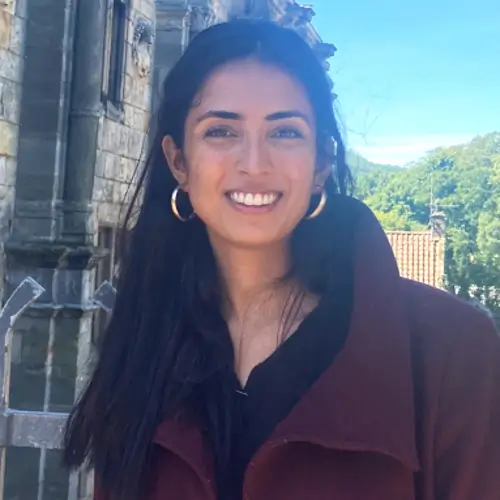
Akila Kadambi is a Postdoctoral Scholar jointly appointed in the Department of Psychiatry and Biobehavioral Sciences at the David Geffen School of Medicine at UCLA and the Brain and Creativity Institute at USC. Building on her PhD work from UCLA, her postdoctoral research investigates the neural mechanisms of empathy and social perception through functional neuroimaging, non-invasive brain stimulation, and neuroethological methods. Current projects examine how narratives and music foster belonging, how the brain supports rehumanization of marginalized groups, and how humanistic neuroscience can inform the development of more trustworthy and empathic AI systems. Her research is supported by Google Research, the Aspen Institute NeuroArts Blueprint, Templeton World Foundation, and Dana Foundation, and published in NeuroImage, Journal of Neuroscience, and Psychonomic Bulletin & Review.
Mass incarceration affects ~1.9 million Americans, with recidivism rates exceeding 40% within three years of release. Simultaneously, law enforcement officers experience burnout and compassion fatigue, which further contribute to adversarial dynamics that undermine rehabilitation and public safety. Traditional interventions often emphasize deficits and pathology, which inadvertently reinforce stigma and “us versus them” mentalities. Missing, however, is a strengths-based approach, specifically focused on what neuroscience may reveal about our shared humanity and our prosocial neural architecture.
This project develops and disseminates a Humanistic Neuroscience Toolkit to teach participants about the neuroscience of empathy, and how social connection shapes brain function. Humanistic neuroscience reframes the clinical focus on pathology toward our intrinsic, shared neurobiology. By understanding that prosociality is neurobiologically fundamental (as opposed to exceptional), the hope is that participants from seemingly opposing groups can recognize their shared humanity through a better understanding of our interconnected neurobiology.
The intervention follows a two-step approach: (1) conducting workshops for currently incarcerated individuals focused on self-understanding through humanistic neuroscience literacy, and (2) parallel workshops for law enforcement officers, civil judges, and police commissioners, aimed at cultivating perspective-taking and reducing implicit biases toward justice-involved populations.
By examining whether noise-limited natural contexts are more likely to promote brain processes conducive to wakeful consolidation than urban environments, this research aims to uncover the mechanisms linking environmental factors to memory while highlighting the potential benefits of equitable green spaces in our communities.
PI: Jesse Rissman, PhD