
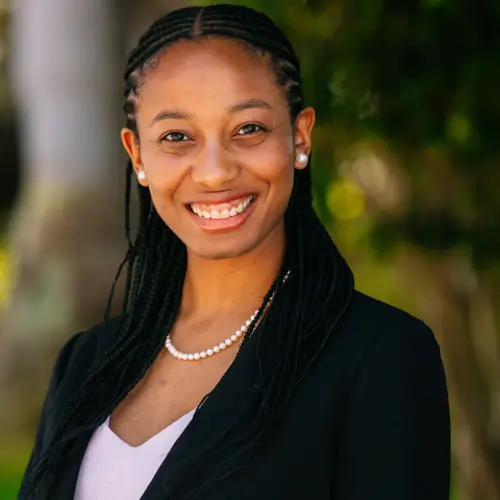
Amani Carson is a medical student at the David Geffen School of Medicine (DGSOM) at UCLA in the CDU-UCLA Urban Health Equity Pathway. Her work focuses on improving access to neurosurgical care and clinical outcomes for neuro-oncology, neurotrauma, and spine surgery patients. Current projects include reducing barriers to neurosurgical-oncological care in underserved communities (with Dr. Kunal Patel, MD), understanding modifiers of clinical outcomes for neurotrauma and spine patients (with Dr. Theresa Williamson, MD), and developing simulation tools to improve patient-surgeon communication with the UCLA DGSOM Simulation Center. Amani was born and raised in Boston, MA and attended Duke University, before moving to Los Angeles with her family and two dogs.
Traumatic brain injury remains a leading cause of death and long-term disability globally, with approximately 20.8 million incident cases in 2021. Despite similar injury severity and access to acute neurosurgical care, outcomes vary widely among patients, with objectively similar injuries resulting in highly disparate outcomes ranging from full recovery to substantial disability or death. Current research has demonstrated that neuroinflammation plays a key role in secondary injury after TBI, shaping both acute neurosurgical course and longer-term recovery. Specifically, neuroinflammatory mediators trigger pathological events (i.e., cell death, microglial activation, chronic neurodegeneration) that can persist long after the initial injury.
Recent studies have highlighted the role of ambient air pollution in inducing chronic systemic and neuroinflammation through microglial activation, oxidative stress, and blood-brain barrier disruption. In particular, particulate matter exposure activates microglia, promotes reactive oxygen species production, and triggers proinflammatory cytokine release; the impacts of which become chronic with prolonged exposure. Communities experiencing higher air pollution exposure are disproportionately “under-resourced” (i.e., “low-income”, low socioeconomic status) and or “underserved” (i.e., historically marginalized racial/ethnic minorities), and these same communities bear a higher burden of severe TBI and worse recovery outcomes.
In this project, I’m seeking to determine if and how environmental factors, specifically markers of ambient air pollution, are associated with neurosurgical outcomes for TBI patients. This will be a single-institution, retrospective, cohort study that uses data from: (1) The electronic health records of patients with a diagnosed TBI seen at a UCLA hospital (UCLA Ronald Reagan neurocritical care unit, UCLA Ronald Reagan and Santa Monica emergency departments); and (2) publicly available air quality data, linked to patients’ geocoded residential addresses, to identify environmental exposures. This will be a hypothesis-generating study to understand which (if any) neurosurgical outcomes are most responsive to environmental exposures, thus laying the groundwork for a prospective, community-partnered investigation.