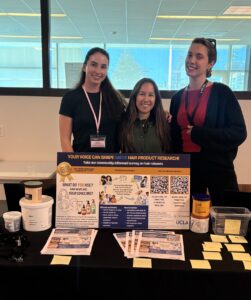

Emma Landskroner is a doctoral candidate in the Department of Environmental Health Sciences at UCLA’s Fielding School of Public Health and a first-year Dana Center Fellow. Her work combines environmental sampling with toxicological assessment using BEAS-2B cells and Drosophila melanogaster exposure models. Current projects examine “green” chemicals, wildfire ash, and community-identified beauty products. Emma is particularly interested in occupational and environmental health disparities and in using community-informed science to prevent exposures that contribute to neurodegeneration and other chronic diseases.
Personal care and cosmetic products are a ubiquitous, yet under-studied, source of chemical exposure. Many products are used daily and applied directly to the skin and scalp, sometimes for long leave-on periods (for example, hair treatments, moisturizers, and fragrances). Exposures extend beyond consumers to those working in occupational settings such as salons and barbershops.
Product markets and use patterns are not uniform across communities. Products tailored for specific hair textures and cultural beauty practices may contain ingredients that are not well characterized for chronic, low-dose effects or real-world mixture exposures. These gaps are relevant to neuroscience because ingredients, and ingredient combinations, are plausible neurotoxicants or neuroendocrine disruptors and may be linked to symptoms people report, such as headaches and respiratory discomfort. South Los Angeles (SPA 6) communities also experience cumulative environmental burdens, making it especially important to understand which everyday products may contribute meaningfully to exposure.
The proposed project represents the community engagement and human subjects portion of the seed grant, “Impact of Personal Care Products on Neuronal Function and Health.” In collaboration with UCLA CTSI Community Engagement and Research Program (CERP), we will connect with 3 to 4 trusted community experts (e.g., salon owners, barbers, hairstylists, or shop owners) who can speak to real-world product application practices, high-use products, and feasible recruitment pathways. With the community advisory committee, we will co-design a brief, bilingual (English and Spanish) electronic survey for adult South LA residents that asks about: (1) the product categories and brands used (haircare, skincare, body care, cosmetics), (2) exposure-relevant patterns of use (frequency, leave-on versus rinse-off, and typical duration of product contact), (3) where products are purchased (for example, salon, beauty supply, online, or big-box retail), (4) any concerns or experiences participants associate with use (for example, irritation, headaches, breathing symptoms), and (5) what product-safety information would be most useful and how the community would like results shared. The finalized survey will help identify which products should be prioritized for subsequent laboratory toxicity testing.
This project examines the effects of chemicals found in personal care products—particularly those commonly used in African American communities—on brain function and health.
PIs: David Krantz, MD PhD | Felix Schweizer, PhD